EOS gets the fundamentals right: a 90-day cadence, a weekly meeting with real numbers, and outcomes assigned to owners. What stops most small teams is the overhead — implementer fees running thousands of dollars per session, per-seat software, and a vocabulary the whole team has to learn before any of it works. Here's every major EOS term in plain English, an honest answer on self-implementation, and how to run the same discipline in a flat-rate tool with zero consultants.
Years ago, before EOS was everywhere, my business partner and I learned a meeting-and-priorities system from the same family tree: the Rockefeller Habits world of annual planning, quarterly priorities, weekly meetings, and scorecards. We ran our version of it for years, and I'd point to it as one of the biggest catalysts in that company's growth.
Over the years since, I've consulted and worked with many organizations that use EOS to run their business. But installing EOS is a heavy lift. For teams of 5 to 50, it can feel overwhelming.
What EOS Gets Right
Credit first, because any honest alternative has to preserve these:
- A 90-day world. People lose focus over a year. Quarterly priorities keep the horizon close enough to feel.
- A weekly meeting that actually reviews the numbers. Same day, same time, same agenda.
- One owner per outcome. EOS is ruthless about names, and that's a good thing.
- An issues list. Problems get written down and worked.
- A plan short enough to read. The V/TO forces strategy onto two pages.
What EOS Actually Costs All-In
The book costs twenty dollars. Implementing the system costs a lot more. Here's where the money goes.
The implementer. Professional EOS Implementers typically charge thousands of dollars per session, and full implementation is usually described as a journey of roughly two years of recurring sessions. Self-implementation options exist, but they aren't always effective.
The software. Ninety, the leading EOS platform, currently runs $12 to $16 per user per month depending on tier. For a 25-person organization, that's $3,600 to $4,800 a year, on top of the implementer.
The jargon tax. This one's invisible on the invoice and very real in the room. Before your team can use the system, they have to learn what Rocks, Scorecards, Level 10s, V/TOs, and IDS mean. I talked to a leader yesterday who wanted to move to a new system but was worried about the new terminology.
Can You Run EOS Without an Implementer?
Yes. Wickman wrote Traction precisely so teams could self-implement, and plenty do. EOS Worldwide will tell you implementer-led adoption sticks better, and they're probably right, for the same reason personal trainers outperform gym memberships: the value is mostly in the accountability, less in the secret knowledge.
But self-implementers rarely struggle with the concepts. Those are pretty straightforward. What trips up organizations is execution. These are habit problems, and one of the biggest reasons habits don't stick is that they're too big.
That's why we designed a lighter system, built to be both understood and executed without a consultant.
The EOS-to-Plain-English Translation Table
Here's the terminology, translated, so you can see which concepts already apply to your organization.
| EOS term | Plain English | What it actually is |
|---|---|---|
| Rocks | Quarterly goals | The 3 to 7 priorities a person or company commits to for 90 days |
| Scorecard | Your weekly numbers | A short list of measurables, reviewed every week |
| Level 10 Meeting | The weekly team meeting | 90 minutes: scorecard, Rock statuses, then mostly issue-solving |
| IDS | Solve problems in order | Identify, Discuss, Solve: work the biggest issue first |
| V/TO | Your plan on one page | Vision, core values, targets, and the quarter's priorities, kept short |
| Issues List | The parking lot that gets worked | Problems written down and processed at the right time |
| To-Dos | Action items with names | Seven-day commitments, reviewed for completion weekly |
| Accountability Chart | An org chart with clear seats | Who owns what function, one name per seat |
| Visionary / Integrator | The founder / the operator | The idea person and the person who runs the machine |
| The 90-day world | Quarterly rhythm | Reset priorities every quarter because annual focus decays |
As you can see, most of these concepts are commonplace, just with sharper focus. Gino Wickman admits as much in Traction.
What Is a Level 10 Meeting, and What's the Lighter Version?
Since plenty of people land here asking: a Level 10 Meeting is EOS's weekly leadership meeting. Ninety minutes, same day and time every week — a quick personal segue, scorecard review, Rock statuses, customer and employee headlines, last week's to-dos, then the bulk of the time solving issues in priority order, ending with a rating of the meeting out of 10.
This is one of the strongest ideas in EOS. Most of the time spent in leadership meetings should go to solving problems instead of reciting status. It's a big reason we built a two-minute weekly check-in into the heart of Alignify. If your weekly meeting still runs on status, start with the five reasons meetings go unproductive.
What Are Rocks, and What's the Sharper Version?
Rocks are 90-day priorities, and the name comes from the classic big-rocks-in-the-jar illustration. Two upgrades are worth making:
- Fewer. EOS says 3 to 7 per person plus company Rocks. In small teams, I've found three should be the ceiling. A few goals done well beats five carried anxiously. We usually recommend three annual goals for the organization and three 90-day goals for each individual.
- Written as outcomes. In practice, most Rocks get written as projects: "launch the new website," "implement the CRM." Projects finish without moving numbers. Writing every quarterly goal as From X to Y by When and Why, with a real baseline, forces the outcome into the open. We break this down deeper in how to set team goals.
Is EOS Overkill for a Small Team or a Nonprofit?
For a team of 5 to 50: usually, yes. The full system assumes a leadership team, a Visionary/Integrator pair, and enough organizational surface to need an Accountability Chart. When everyone fits in one room, you're paying framework overhead to solve coordination problems you don't have.
For nonprofits and churches the fit is usually worse, and nobody selling EOS brings that up. The framework assumes a for-profit leadership team. Visionary and Integrator don't map cleanly onto an executive director who answers to a board, or a senior pastor working next to an executive pastor. Then there's the vocabulary. I've sat in a church staff meeting where "our Rocks" took five minutes to explain before anyone could talk about the actual work.
Mission-driven teams need the same disciplines in language people already use, on a rhythm that works around volunteers, at a price a board won't argue about.
The Same Discipline Without the Overhead
The disciplines that make EOS work are a small number of quarterly priorities with owners, a weekly review of honest numbers, an issues list, and a quarterly reset.
You'll find familiar — maybe even more approachable — versions of all of them in Alignify:
- Three organization-wide annual goals, each written From X to Y by When and Why, each with one owner.
- 90-day goals assigned to every individual, written in the same clear framework.
- A two-minute async weekly check-in with On Track / At Risk / Off Track statuses.
- A scorecard of your handful of weekly numbers.
- An issues list where anyone can flag things that should be discussed.
- A meeting agenda built to keep the most important things front and center.
- A sub-three-hour quarterly reset.
Alignify runs all of it for $99 a month flat, unlimited seats, self-serve setup in an afternoon. Against Ninety's per-seat pricing, a 25-person team saves a couple thousand dollars a year and skips the vocabulary lessons entirely.
If you're comparing more broadly, the checklist in how to choose team alignment software applies to every option, including ours.
Frequently Asked Questions
Can You Run EOS Without an Implementer?
Yes. Traction was written for self-implementation. Expect the challenge to be sustaining the weekly and quarterly rhythm, and choose your tools for that problem specifically.
Is EOS Worth It?
For a company with a leadership team, real management layers, and the budget for an implementer, it can be. For a team of 5 to 50, the same core disciplines are available without the framework's cost and ceremony.
What's a Simpler Alternative to EOS?
Three organization-wide goals with owners, individual quarterly goals written From X to Y, a two-minute weekly check-in with honest statuses, a short scorecard, and a quarterly reset. The disciplines survive; the overhead doesn't.
What Does EOS Cost All-In?
Roughly: implementer sessions running thousands of dollars each over about two years, plus EOS software at $12 to $16 per user per month, plus the internal time to teach and maintain the vocabulary.
One Last Thing
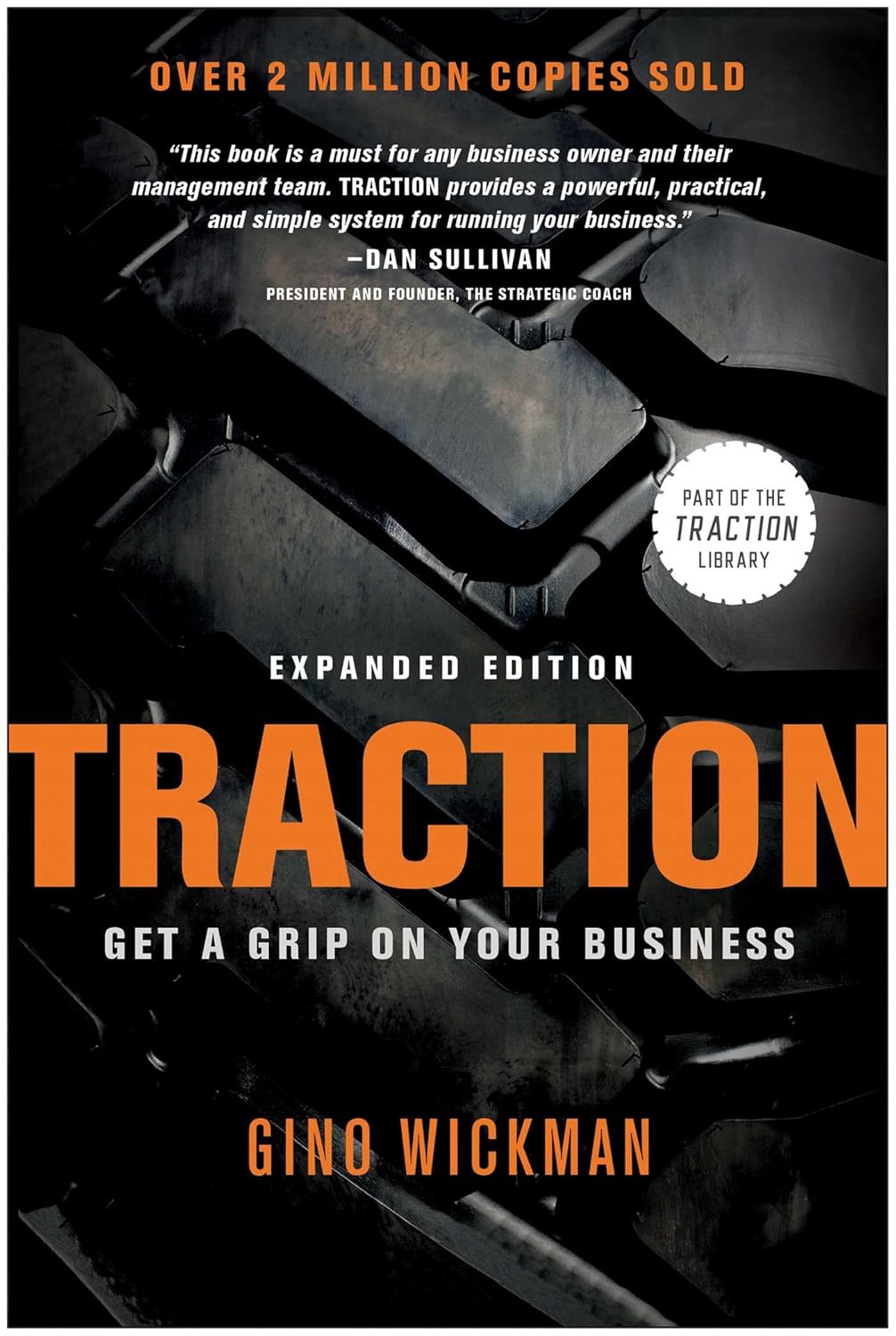
Recommended reading
Traction: Get a Grip on Your Business
If you're curious about EOS, read Gino Wickman's Traction. It's a useful book, and you'll finish it understanding all of these terms. Then, before you sign anything, run this experiment: three goals, owners, and four weeks of two-minute check-ins, in whatever tool you have. If your team sustains that for a month, you might be a good fit for EOS.
Buy the book on AmazonEOS®, Level 10 Meeting™, V/TO™, and related terms are trademarks of EOS Worldwide, LLC. Alignify has no affiliation with EOS Worldwide; the framework is discussed here descriptively, for comparison.
Michael Lukaszewski
Michael is the founder of Alignify. He writes about goals, planning, and helping teams stay aligned on what matters most.