A staff meeting wanders for a simple reason: the goals that matter most sit last on the agenda, which makes them the first thing cut when the hour runs long. The simplest fix is to start the meeting with goals, spending the only fifteen minutes nobody ever reclaims on the three things that matter most. Your goals are almost never urgent in a given week, and that's exactly why they need a protected slot instead of whatever time is left. The rest of the meeting still happens. It happens after the important part is done.
When I talk with leaders about their staff meetings, almost all of them say the same thing. Everyone likes each other, the meeting is fine, but it could be more productive.
Then I ask about agenda or flow. It usually starts off with an opener that was supposed to take five minutes and takes twenty, then there are updates from around the room, and it usually ends up on whatever is most urgent for the coming week.
That was typical for my staff meeting when I was pastoring. This hour-long meeting, full of capable and committed people, rarely reached its potential. The people responsible for where the organization goes next were sitting there, mostly just listening, often thinking about other things. What if we could focus that energy? What if we had a structure that encouraged engagement?
Here's the question that I think gets us closer to that better way: what if we started the meeting with goals?
Instead of announcements, updates, and problems, what if we started by talking about the things we already decided were most important? A goals-first agenda might just be the thing that re-energizes your team meeting and pushes you toward effectiveness.
Why Do Staff Meetings Wander?
The research on this is consistently bleak. Donald Sull, Rebecca Homkes, and Charles Sull found that only 55% of middle managers could name even one of their company's top five priorities (Harvard Business Review, 2015). Nearly half couldn't name a single one. FranklinCovey's xQ research with Harris Interactive put it at 15% of employees who can name their organization's top three goals.
In one survey we ran with 300 church leaders, 39% said goals come up rarely or never in their meetings. Not rarely in the staff meeting. Rarely in any meeting. Nothing about that is particular to churches, and every leader I show it to recognizes their own calendar in it.
None of those teams lack goals. Their goals just aren't on the agenda of the one hour where the whole team is in the room.
So go look at your last few staff meeting agendas.
If your goals are anywhere below the halfway point, you've already decided they're optional. You decided it whenever somebody built the running order, and you've been re-deciding it every week since.
The last item on an agenda is the first thing you cut, and nobody announces the cut. Issues run long. Someone has a real problem and it deserves the time. The meeting ends where it ends, and whatever was sitting at the bottom quietly doesn't happen. Do that for eleven weeks and you get to the end of the quarter wondering why nothing moved on the work you said mattered most.
Why Does Urgent Work Always Win the Hour?
In August of 1954, Dwight Eisenhower gave an address to the Second Assembly of the World Council of Churches in Evanston, Illinois. He quoted a former college president he declined to name: "I have two kinds of problems, the urgent and the important. The urgent are not important, and the important are never urgent."
Stephen Covey turned it into the four-quadrant grid in The 7 Habits of Highly Effective People in 1989, and most people now call it the Eisenhower matrix. You don't need all four boxes to run a better meeting. You need one of them.
Covey called it Quadrant II: important and not urgent. Planning. Preparation. The work that builds something instead of putting something out. He argued it's where effective leadership actually lives, and that it's the quadrant everybody skips, because nothing in it is ever due today.
Your three goals live in Quadrant II permanently. That's what makes them goals. If your quarterly goal were urgent this week, it would be a task and you'd have finished it Tuesday.
Now look at what your agenda is made of. Announcements are urgent. The calendar conflict is urgent. The parking lot item somebody raised on Thursday is urgent. Whoever emailed you at 11pm is urgent. Every one of those things will beat your goals in a fair fight, every single week, because urgency is loud and importance is patient.
So don't have a fair fight. Put the important thing first, before the urgent things have a chance to fill the hour.
What Does Starting With Goals Actually Buy You?
Three things, and the first is the obvious one.
You don't run out of time. The first fifteen minutes of a meeting is the only fifteen nobody ever reclaims. Nothing has run long yet. Nobody has gone off on a tangent yet. Whatever occupies that block is the one thing you are guaranteed to do every week.
You connect the plan to the week. Your goals are the layer between the mission you wrote and the tasks people do on Tuesday. When goal owners report On Track, At Risk, or Off Track in front of the whole team, the annual plan stops being a document and becomes something the team touches every seven days. Teresa Amabile and Steven Kramer analyzed roughly 12,000 workday diary entries for The Progress Principle and found that visible progress in meaningful work is the strongest driver of a good day at work. A meeting that opens by showing what moved does that on purpose. A meeting that opens with announcements does the opposite.
People know what's coming. When goals lead every week, the person who owns one knows on Thursday that she reports on Monday. The meeting stops being a place where work gets described and becomes the deadline that produces it. That's a change in how the other six days run, bought with a change to the agenda.
What Kind of Goals Are We Talking About?
Two kinds, and the difference decides what actually goes in that fifteen-minute block.
The organization sets annual goals. Three of them. These are the outcomes the whole team is responsible for this year, and everyone on staff should be able to name them without looking anything up.
Individuals set 90-day goals. Each person carries up to three for the quarter. A year is too long to hold in your head, and a month is too short to finish anything worth finishing. Ninety days is the window where one person can see a goal from start to done.
The two connect through ownership. Whoever owns one of the annual goals carries it as their primary goal for the quarter. Organizational goals aren't a separate list running alongside personal ones. They're the most important individual goals, with the weight of the whole team behind them.
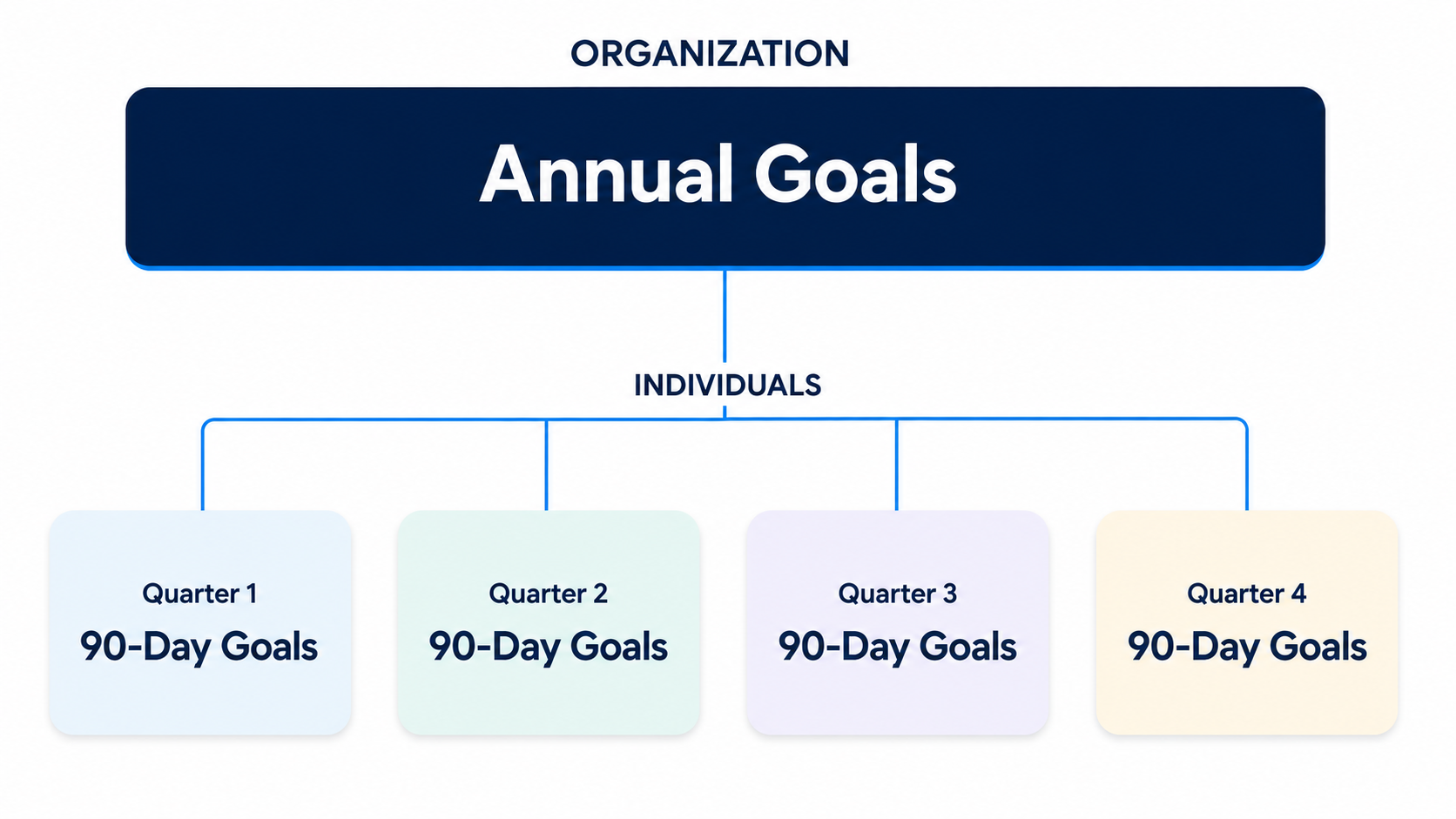
The organization sets annual goals. Individuals set 90-day goals each quarter that connect back to them.
Here's the test. The person running your smallest department should be able to name her three goals for this quarter and tell you which of the organization's annual goals each one connects to. If she can name hers but can't make that connection, you have activity. If she can make the connection, you have alignment.
So in the meeting, the fifteen minutes belongs to the three organizational goals, reported by their owners. Individual 90-day goals belong in the written check-in and in one-on-ones. Skip that distinction and a team of ten walks into a fifty-minute meeting carrying thirty goals, which is how a good idea dies in week two.
What Agenda Should You Use?
You can build a staff meeting agenda that works for you, but here's the template we propose in our Staff Meeting Challenge. We call it the 50-Minute Meeting.
- Goals, 15 minutes. Your three, each owner reporting On Track, At Risk, or Off Track. Only the yellows and reds get discussion. Green gets ten seconds and a nod.
- Scorecard, 5 minutes. The handful of numbers you watch every week. Reported, not discussed, unless something is off.
- Issues, 20 minutes. Rank the list first, then work the top one until it's decided.
- Action items, 5 minutes. Who does what by when, read out loud.
- Wins and kudos, 5 minutes. End on people.
If your team opens with something before the work starts, a devotional, a personal check-in, a safety moment, put it on top and don't count it against the fifty.
Kudos sits at the end on purpose. The meeting closes on people rather than on a task list, which is the honest answer to anyone who thinks a tight agenda makes a team feel like a factory. It also means kudos is the first thing a long meeting eats, so if you find yourself cutting it most weeks, the meeting isn't finishing on time and that's the problem to fix.
When we build agendas, the blocks never change. But the content inside those blocks is always current. If you're using Alignify, the blocks populate automatically with current data, so you never have to leave the screen. No more people pulling up a spreadsheet or logging into another system while the meeting is happening, which often means they get lost down a rabbit hole.
A standing agenda isn't rigid, because rigid would mean the same content every week. Same blocks, current data. It also means anyone can run the meeting.
What If You Don't Have Three Clear Goals Yet?
Plenty of teams are in this spot, and there's no shame in it. You have direction, you have a busy calendar, and you don't have three written goals with a name on each one. Putting an empty block at the top of your meeting won't help. So write the goals first, in the From X to Y by When and Why format, and start the agenda change the week after you have them.
If you already have goals and they're just not written where the team can see them, you're closer than you think.
Frequently Asked Questions
How Long Should the Goals Section of a Staff Meeting Be?
Fifteen minutes for three goals, in a fifty-minute meeting. Most of that time goes to the goals that are At Risk or Off Track. Goals that are On Track get a status and nothing more, which is what keeps fifteen minutes realistic. If you're spending the whole block on goals that are going well, you're using the time to feel good rather than to fix something.
What If Our Goals Never Change Week to Week?
They shouldn't change much. Quarterly goals move slowly, and that's normal. What changes weekly is the status, the blocker, and what the owner did about it. If a goal genuinely shows no movement for three straight weeks, that's not a boring agenda item. That's the meeting telling you something, and it belongs in the issues section.
Should We Still Do Announcements and Updates?
Yes, in writing, before the meeting. Announcements and individual updates are information transfer, and information transfer doesn't need everyone in a room at the same time. Move them to a written check-in that people read before they walk in, then use the live hour for the things that actually need the whole team: progress, blockers, and decisions.
Does This Work for a Team of Four?
Yes, and shorten it. Same order, thirty minutes instead of fifty. Small teams often need this more than large ones, because there are fewer hours to waste and one bad meeting is a bigger share of the week.
Who Should Run the Meeting?
Whoever isn't holding the strongest opinion on the hardest issue. That's often an operations lead or a second chair rather than the senior leader. A standing agenda makes this possible, because the person running the meeting doesn't have to design it. They just have to hold the order and watch the clock.
Change One Thing This Week
Open the agenda for your next staff meeting and move your goals to the top. Don't redesign the rest of it yet. Put the three things you said mattered most into the first fifteen minutes and see what the hour does differently.
If the goals aren't written down anywhere your team can see them, start there instead. The Goal Setting Guide walks through the format and gives you worked examples for business, nonprofit, and church teams.
Your team gives you that hour every week whether it's good or not. The order you put things in decides what they get back for it.
Free On-Demand Training
Why Staff Meetings Stink (And How to Fix Yours)
A free on-demand training on the five reasons staff meetings go flat, the STAFF framework that fixes all five, and a standing agenda you can run in next week's meeting.
Watch the Free TrainingFree to watch. No obligation.

Michael Lukaszewski
Michael is the founder of Alignify. He writes about goals, planning, and helping teams stay aligned on what matters most.