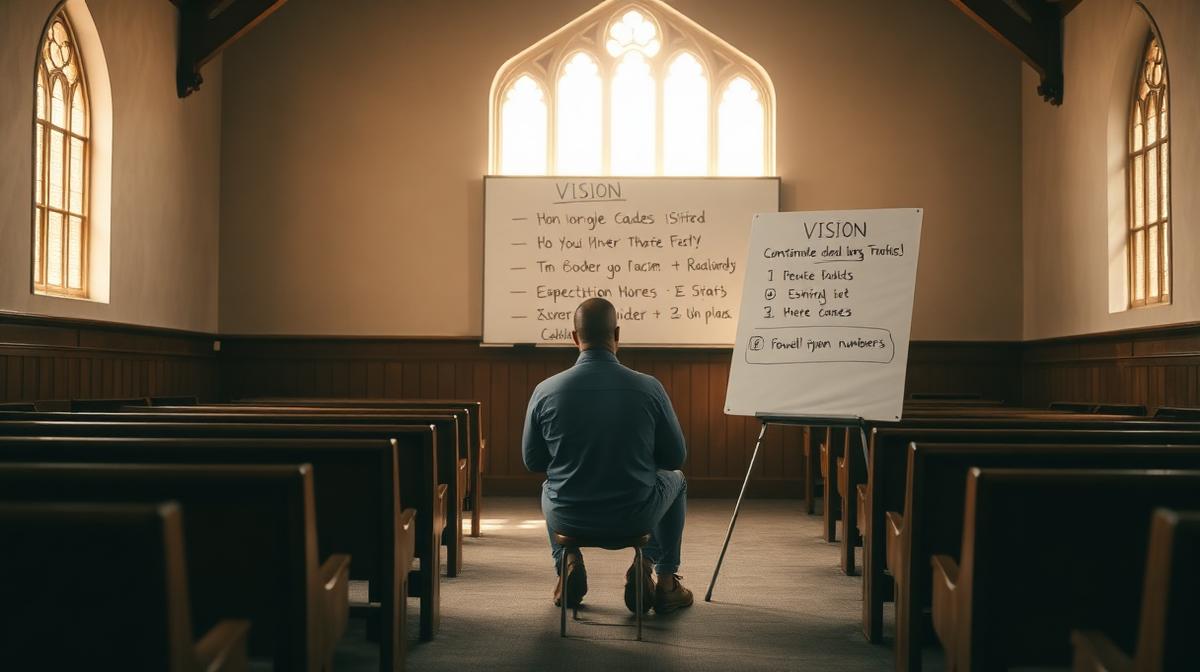
Mission-driven leaders are skilled at casting vision but rarely define the measurable gap between where things are now and where they need to be. That missing piece is where momentum dies. The fix is a goal structure honest enough to name the current reality and specific enough that anyone on the team can say whether you're getting there.
Most mission-driven leaders are better at vision than they are at clarity. I was one of them. As a pastor, casting vision was the part of the job I loved, and I could describe where we were headed with real conviction. People followed because they believed it too.
Vision deserves no criticism. It's what got you into this work, whether you lead a church, a nonprofit, or a purpose-driven company, and it keeps you going when the work is hard and the results are slow.
But there's a question your vision doesn't answer, and it's the one your team is quietly asking every week: how do we know if we're getting there?
More vision doesn't answer that question. A goal written well enough that anyone on your team can tell you, on any given day, whether you're on track answers it. Most mission-driven goals can't do that. They weren't written to.
The real reason goals don't stick in mission-driven organizations
Most of the resistance to goal-setting in churches and nonprofits is legitimate. Here's where it actually comes from:
- Goals feel like they belong in a boardroom. The work is a calling, and reducing it to numbers can feel like it misses the point entirely.
- Vision and purpose feel like enough. If the mission is clear, why does the team need a spreadsheet to know how it's doing?
- Past attempts haven't worked. Goals got written at a planning retreat, lived in a document nobody opened, and disappeared by spring.
- The process felt too complicated to sustain. SMART goals, OKRs, KPIs: frameworks imported from the corporate world that demand more infrastructure than most small teams have or want.
These are real reasons, and they explain why so many mission-driven leaders have quietly concluded that formal goal-setting doesn't fit their context.
That conclusion has a cost. Gallup research shows only 16% of employees can name their organization's top priorities. The number doesn't improve because an organization is mission-driven. It improves when leaders give their teams something specific enough to hold onto: a defined destination, on top of a direction.
The problem was never goals. The problem is how most mission-driven goals get written.
The difference between a vision and a goal
Most leaders treat vision and goals as the same thing. They aren't.
A vision describes the future you're building toward. It answers "where are we going?" A goal describes the specific progress you're committed to making in a defined window of time. It answers "how will we know we're getting there?"
Both matter. They do different work, and they run on different clocks. Purpose holds forever. Mission holds for one to three years. Goals and plans live in 90-day cycles, reviewed in the meetings you already hold, and tasks turn over weekly. Most organizations have the left half of that chain and the right end, with nothing defined in between.
When a leader says "we want to grow our small groups" or "we want to serve more families," that's a vision statement standing where a goal should be. It points a direction without defining a destination. Nobody can tell you, six months from now, whether you got there, because "grow" was never defined. Andy Stanley put it plainly: "A goal without a number is just a slogan."
Northland Church in Florida learned this during a period of small group decline. Their team skipped the "strengthen community" language and got specific: they counted current active groups, set a target, assigned ownership to one staff member, and built a timeline. The mission didn't change. But for the first time, the team could see whether the work was moving, because the goal made progress visible.
A real goal doesn't replace vision. It makes vision trackable.
The From X to Y by When and Why structure
Most goal frameworks ask you to start with the target. This one asks you to start with the truth: where things actually are right now.
Four questions. Where are things today? Where do they need to be? By when? And why does it matter to the mission? That's the whole structure: From X to Y by When and Why.
From X: name the current reality. This is the piece most leaders skip, and it's the most important one. Naming where things are means admitting a number you might not be proud of. How many active volunteers do you have right now? How many first-time guests or new donors came back last month? What's the real count, on paper, today?
X is what makes the goal honest. Without it, you're asking your team to work toward a target with no shared sense of the starting line.
To Y: define what success looks like. The test is simple: could anyone on your team tell you, six months from now, whether you got there? A number, a condition, a threshold that is either met or not. If the answer is fuzzy, the goal isn't done yet.
By When: set a deadline that creates focus. A goal without a timeline is a wish. Quarterly tends to work better than annual in mission-driven work. A year is long enough to lose the thread entirely. Ninety days is enough time to move something real and short enough that you can't hide from the results.
And Why: state the mission rationale. This is where most leaders say "that's obvious" and move on. It usually isn't. Every team has at least one person quietly asking "why are we spending time and money on this?" If the why lives only in the leader's head, it doesn't exist for the team. Write it down. Say plainly how this goal connects to what your organization is actually called to do.
The why does something else too. It puts a real conversation on the table early. When a team member disagrees with the rationale, you want to know in week one, and without a written why, you find out in week ten.
Weak goals and strong goals, side by side
Small groups (church)
Weak: Grow our small groups.
Strong: From 14 active small groups to 22 by June 30, because consistent community is the primary way our church helps people move from attending to belonging.
Program enrollment (nonprofit)
Weak: Reach more students.
Strong: From 60 to 100 students enrolled in the after-school program by September 1, because the waiting list proves the need and our funding depends on enrollment.
Recurring giving (either)
Weak: Increase generosity.
Strong: From 187 recurring giving units to 240 by December 31, so we can fully fund the children's program expansion without drawing from reserves.
Same mission. Same team. Completely different level of clarity.
Why the Why is the part most leaders skip
Goals without a stated rationale feel like management. Goals with one feel like mission.
Tim Keller wrote about this discipline from his years leading Redeemer Presbyterian in New York: organizational decisions carried a ministry rationale, so the question was never just "what are we trying to accomplish" but "why does this matter for the people we serve." The goals served the mission as the church scaled. A goal is a tool in service of a calling, and it holds that place only when the why is written down.
When the why is missing, everyone fills in their own version. Each person has a quiet answer to "why are we doing this," and those answers rarely match. You end up with a team technically aimed at the same target while operating from different stories about what it means. That gap shows up in how people prioritize, how they handle setbacks, and whether they stay engaged past the first month.
And if you find the why hard to articulate, pay attention to that before you assign the goal. A goal whose mission rationale won't come is often a goal that shouldn't be on the list.
One Last Thing
Vision tells your team where you're going. A well-written goal tells them whether you're getting there. Your organization needs both.
Here's what I want you to do this week. Pick the one area where you feel most stuck or unclear, and write a single goal in the From X to Y by When and Why format. Check it against the four questions. If it doesn't answer all four, you've found the work, and twenty honest minutes will finish it.
The full format, with worked examples across organization types, is in our Goal Setting Guide.
Your team already believes in the vision. Give them a way to see it moving.

Michael Lukaszewski
Michael is the founder of Alignify. He writes about goals, planning, and helping teams stay aligned on what matters most.