
You've written a goal and sketched the six parts of a plan. This is the working session that turns them into a document your team can run: the brain dump, the sequencing, the milestones, the weekly indicators, and the feedback pass that catches blind spots before week ten does. If you haven't read the six-part plan structure yet, start there and come back with your goal in hand.
I've built this document with church staffs, nonprofit teams, and small companies, and the process is the same in every room. You've set a goal. Now you need the route, written down at a level of detail where next week's work is obvious.
That's what this walkthrough produces: a working plan that tells you what to do next week, next month, and the month after that.
Write the goal at the top
Start with the full goal statement: From X to Y by When and Why.
Example: "From 60% of staff feeling unclear about priorities to 90% reporting clear understanding of their top three goals by September 30, because unclear priorities lead to wasted effort and burnout."
Everything you write from here should connect back to this sentence. If the goal itself is still fuzzy, fix that first with the From X to Y formula.
Add context
Write two or three sentences on why this goal matters right now. What's the situation? What happens if you don't accomplish it?
Example: "Three staff members told me last month they don't know what success looks like in their role. Two others are working on projects that don't connect to our annual priorities. This is creating frustration and wasted time."
Notice what that example does: it names real people and real consequences. Generic background about why alignment matters would tell the reader nothing.
Define what done looks like
Write three to five success criteria: concrete, verifiable outcomes that prove you hit the goal.
The test for each one: could someone else verify you accomplished this without asking you to explain?
Example:
- 90% of staff can name their top three goals when asked
- All staff have written goals documented in our system
- Staff survey shows a 9/10 average on "I understand what success looks like in my role"
- Zero staff meetings in Q4 where someone asks "what should I be working on?"
If you hit all of these, you accomplished the goal. If you can't tell, the criteria need work.
Brain dump all the activities
Write down every significant action that needs to happen between where you are and where you're going. Don't organize yet. Just capture.
Use this format: action verb plus specific outcome.
Example: "Conduct 60-minute training session covering goal format and weekly check-in process."
That's specific enough that you'd know exactly what to do when the time comes. "Train staff" leaves too much room for interpretation, and vague activities are where plans go to stall.
Keep going until you've captured the critical path. Ten activities is fine. Thirty is fine. A full list for the staff clarity goal might include:
- Draft one-page goal template showing the format
- Write 5 example goals from different roles
- Create simple weekly check-in format
- Present draft to leadership team meeting
- Incorporate leadership feedback and finalize framework
- Schedule all-staff meeting for goal training
- Prepare training presentation with step-by-step walkthrough
- Conduct 60-minute training session
- Send follow-up email with template and deadline
- Schedule 30-minute one-on-one with each staff member
- Help each person draft their three goals during the one-on-one
- Review all submitted goals for clarity and alignment
- Enter all goals into the tracking system
- Send reminder about the first weekly check-in
- Review first week of check-ins for common issues
- Address any confusion in the team meeting
- Run mid-quarter pulse survey on goal clarity
- Adjust the process based on feedback
Put them in order
Look at the list and ask: what has to happen first?
Number the activities in the order they need to happen. If several things can run at the same time, give them the same number.
Identify the natural milestones
Now look at your ordered list for the natural breaking points, where one phase of work ends and another begins.
Milestones are significant deliverables or decisions that mark real progress. Each one should feel like: "if we get this done, we've accomplished something meaningful."
Example milestones for the staff clarity goal:
- Goal framework finalized
- Staff trained on the process
- All staff have written goals
- First check-in cycle complete
- Mid-quarter validation done
Milestones emerge from sequencing the work rather than being imposed on it. You might have three. You might have seven. Let the work tell you, then give each one a date.
Choose what to track weekly
Pick two or three leading indicators that signal whether the plan is working before the final result shows up.
For the staff clarity goal:
- Number of staff with three written goals in the system
- Percentage of staff completing weekly check-ins on time
- Themes surfacing in check-in comments
These tell you early whether the plan is working. Tracking "hours spent on goal planning" or "number of meetings held" tells you nothing, because effort was never the question.
Get feedback
Share the draft plan with three to five people who will be affected by the goal or who can see what you can't. Ask specific questions:
- What am I missing in the activities?
- Which sequence doesn't make sense?
- What dependencies am I not seeing?
- Where have you seen this go wrong before?
You're looking for blind spots. A question that costs you nothing in week one costs you a lot in week ten. Revise, then start executing.
When things go off track
When your weekly check-in shows yellow or red, don't reach for the goal. Open the plan and ask:
- Is the approach wrong?
- Is the timeline unrealistic?
- Is there a dependency I missed?
- Do I need help I don't have?
Then fix the plan. Adjust activities, resequence the work, add resources, change the approach.
The goal stays fixed. The plan is what you change.
How this works in Alignify
In Alignify, every goal can carry a plan. From the Goals Snapshot you can see all goals at a glance, with a Plan icon marking which ones have an execution plan attached.
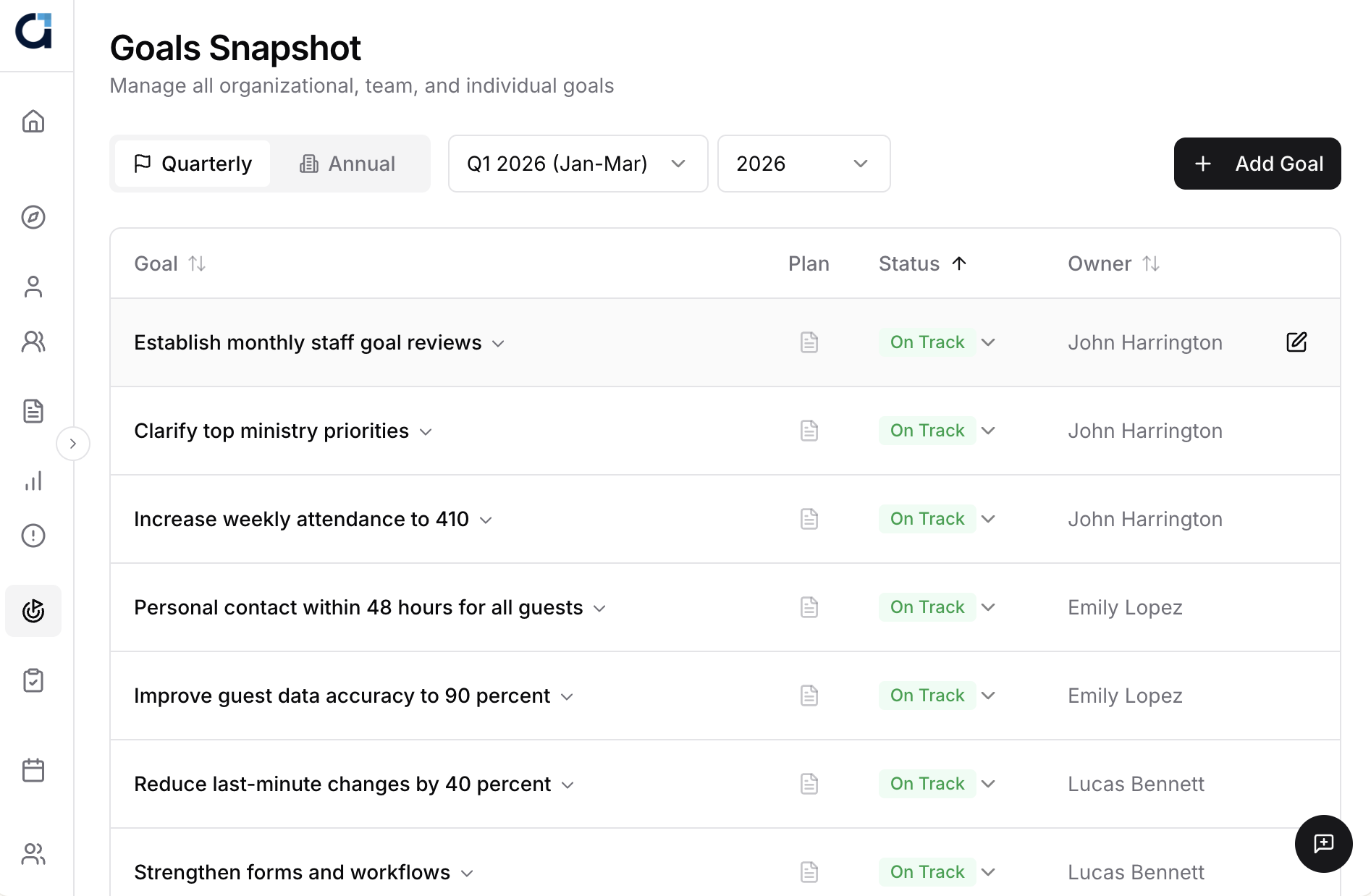 The Goals Snapshot shows all goals with their status and plan indicators.
The plan editor gives you structured sections for Context, Approach, Key Activities, and the rest, and the Draft with AI button generates a starting point from your goal and organizational context. Refine it to match your situation, or start from scratch.
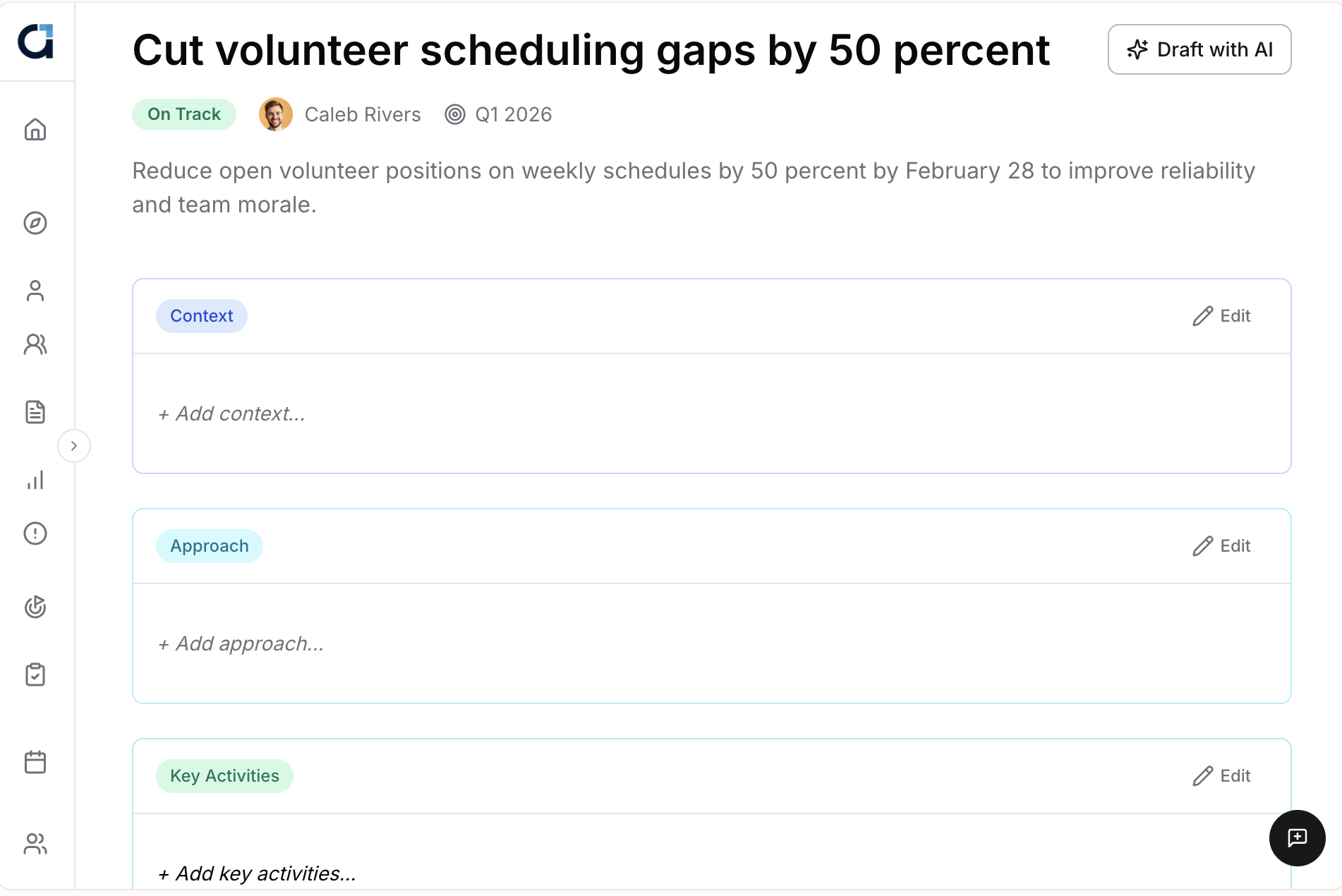 The plan template includes structured sections with optional AI-assisted drafting via the "Draft with AI" button.
One Last Thing
Here's what I want you to do this week. Take your most important goal and run the brain dump: every activity, action verb plus outcome, no organizing allowed until the list is done. It takes twenty minutes and it's the step most leaders skip, because capturing feels less impressive than strategizing. Then sequence it, mark the milestones, and hand the draft to one person who'll tell you what's missing.
A goal tells your team where you're going. This document is how they'll know what to do on an ordinary Tuesday, and ordinary Tuesdays are where goals are actually won.
Alignify Team
Contributor at Alignify.