
Most teams set goals and call it planning. Those are two different jobs, and skipping the second is why good goals stall by spring. Here are the six parts of a plan your team can actually run, a worked example you can copy, and a one-page worksheet to build yours this week.
In 2005, my family and I moved to Atlanta to start a church. We launched in a movie theater with a team of 25 committed people, and by our one-year anniversary we were over 500.
From the outside, everything was working.
I knew how to attract a crowd. I had vision to spare, and I could preach it every Sunday. But about eighteen months in, I had to admit something to myself. We had big goals for discipleship, for groups, for following up with guests and givers, and every one of them was stuck at the wishing stage. I would get mad at a problem, throw some attention at it, and watch it come back a month later.
I've since watched hundreds of church and nonprofit teams live some version of that same story. The goal gets set in January with real energy. "We want more people in small groups." Everyone nods. By March the goal is still technically true and completely dead.
The missing piece is the plan. And the good news is that building one is a teachable skill, with parts you can learn.
A goal is a destination. A plan is the route.
A goal to lose ten pounds is really just a wish until there's a plan behind it. How you'll eat. How you'll move. Who's checking in with you. The goal on its own does nothing.
"Save $10,000 this year" is the same. The number is motivating. But nobody saves $10,000 because they wrote down $10,000. They save it because they decided how much comes out of each paycheck, what they're cutting, and where it goes automatically.
The goal is the part that inspires you. The plan is the part that gets you there.
The goal is the WOW. The plan is the HOW.
Henry Cloud says hope is not a strategy. Most stalled goals have plenty of hope behind them. What they're missing is the plan.
The Six Parts of a Good Plan
A good plan has six parts. Here they are.
1. The Goal
A plan can only be as clear as the goal underneath it. If the goal is "grow our membership," there's nothing to plan against, because there's no starting line, no finish line, and no number.
Write the goal as From X to Y by When and Why. "Increase weekly attendance from 120 to 180 by December 31, because connected people stay." That gives you something to build on. The vague version does not.
If your goal is still fuzzy, fix that first. Everything downstream depends on it.
2. Approach
Before you list a single task, answer one question: how are you actually going to do this? The main strategy, in two or three sentences. The thing you'd say to a board member who asked, "So what's the plan?"
Here's what that could look like in a few different worlds:
- If you're a nonprofit and your goal is to grow from 85 to 150 monthly recurring donors, your approach might be: convert existing one-time donors instead of chasing new ones. They already trust us. One fall campaign, plus a personal ask from the ED to our top 200.
- If you run a small business and your goal is to lift monthly recurring revenue from $40K to $60K, your approach might be: grow existing accounts instead of new logos. Every customer over six months old gets a review call and an upgrade path. Outbound is paused this quarter.
- If you lead a church and your goal is to raise your first-time guest return rate, your approach might be: close the gap in the first 72 hours after a visit. We're betting on speed and personal touch over more programming.
- If you're a school booster club and your goal is to grow from 40 to 100 member families, your approach might be: stop recruiting at games and start recruiting at registration, where every family already has their calendar open.
The approach is where you make your real choices. You're deciding what you'll lean into and, just as much, what you'll leave alone. A team that can't write its approach in two sentences usually hasn't decided yet.
One word of caution. In a 90 day period, you may try 1-3 approaches, but you shouldn't spread yourself too thin or try to hedge your bets too much. An approach is kind of like a bet, so bet with confidence.
3. Key Activities
Now you get specific. Three to five concrete moves your team is actually going to make. Rebuild the follow-up sequence. Train the team. Move the meeting. Real verbs, real things a real person will do.
Take the nonprofit from above. The approach was to convert existing one-time donors. So the key activities almost write themselves:
- Pull the list of every donor who gave once in the last 18 months
- Build one conversion email sequence with a single ask: become monthly
- The ED personally calls the top 200 with a direct invitation
- Add a "make it monthly" option to every thank-you page
Same with the small business. The approach was to grow existing accounts and pause outbound. So:
- Schedule a review call with every customer past the six-month mark
- Build one upgrade path with clear pricing before the calls start
- Turn off the outbound sequences for the quarter and reassign that time to the calls
Notice what's on those lists and what isn't. No "improve donor communication." No "focus on customer relationships." Every line is something one person can start on Monday. And notice that a different approach would have produced a completely different list. If the nonprofit had bet on new donor acquisition instead, none of these four activities would exist.
Here's the test for each one. If this activity didn't happen, would the goal stall? The ones that would stall it belong on the list. The ones that wouldn't, cut.
4. Milestones
A quarter is twelve weeks, which is just long enough to lie to yourself about progress. Milestones keep you honest.
A milestone is a date plus what has to be true by then. Within a quarter, monthly is the natural rhythm, so you'll usually land on three or four. Attach a number wherever you can.
Milestones turn a far-off target into checkpoints you can feel. Hit the first one and you know you're on track. Miss it and you find out in week four instead of week eleven, while there's still time to do something about it.
5. Success Criteria
Beyond the headline number, what will be true when this works? What will you see on a busy Sunday, hear from a frontline volunteer, stop losing sleep over?
Naming the finish line in full keeps the goal from becoming cold math. It also settles arguments in October about whether you actually won.
6. Sign-off
One human puts their name on the plan, and at least one other human sees it.
Sometimes that's a leader who approves it. But sign-off is bigger than approval. It's your chance to get other eyeballs on the plan before you run it.
Every reader makes the plan better. A teammate catches the milestone that's too optimistic.
Someone asks what "rebuild the sequence" actually means. Questions like that cost you nothing in week one and a lot in week ten.
There's a deeper principle here, and we built Alignify on it: plans work better out in the open. When the team can see the plan, they help carry it. We call it ambient accountability.
A plan with no one else's eyes on it is easy to abandon quietly. Signed and seen, it becomes a shared commitment.
This is where alignment actually happens.
What a filled-out plan looks like
Here's a goal a lot of churches would recognize. Swap in new donors, signups, or customers and the shape holds.
- Goal: Grow our first-time guest return rate from 18 percent to 35 percent by September 30, because guests who come back a second time are far more likely to stay and get connected.
- Approach: Close the gap in the first 72 hours after a visit, and give every first-time guest one clear, warm reason to come back.
- Key Activities: Rebuild the first-time guest email sequence so the first email goes out within 24 hours. Train the weekend team to personally meet every first-timer and capture their info before they leave. Add one specific second-visit invitation to the follow-up, like a newcomer lunch.
- Milestones: End of month one, new sequence live and team trained. End of month two, return rate at 25 percent. End of month three, return rate at 35 percent.
- Success Criteria: Every guest gets a personal touch within three days, and by the end of the quarter we can name our returning guests instead of guessing.
- Sign-off: Owned by our connections director. Reviewed by me and the executive pastor before the quarter starts.
One page. Every line is something a real person will do. And you'll know by the end of month one whether it's working.
Now write it down
A plan is a document. Something you can hold, hand to someone, and point at.
Which means the whole move is simpler than most leaders expect. Write it down.
When God gave Habakkuk a vision, the instruction that came with it was to write it down and make it plain, so whoever read it could run with it. Plain enough to run with. That's the standard for your plan too.
If you want to get people on the same page, create an actual page.
Most plans live in the leader's head, or worse, across four people's heads in four different versions. A plan that only exists in your head is an intention you're hoping everyone shares. And here's why writing it down matters more than getting it right: a bad plan you can look at, review, and improve.
A plan nobody can see can't be fixed. A rough plan on paper beats a brilliant plan in your mind every time.
Pick your best next step
You already did the hard part when you decided what matters. Before your next planning meeting, take your single most important goal and give it twenty minutes. Write the approach. Name the few activities that matter. Set a milestone for each of the next three months. Then hand it to one person and ask them to keep you honest. Here are three ways we can help you get there.
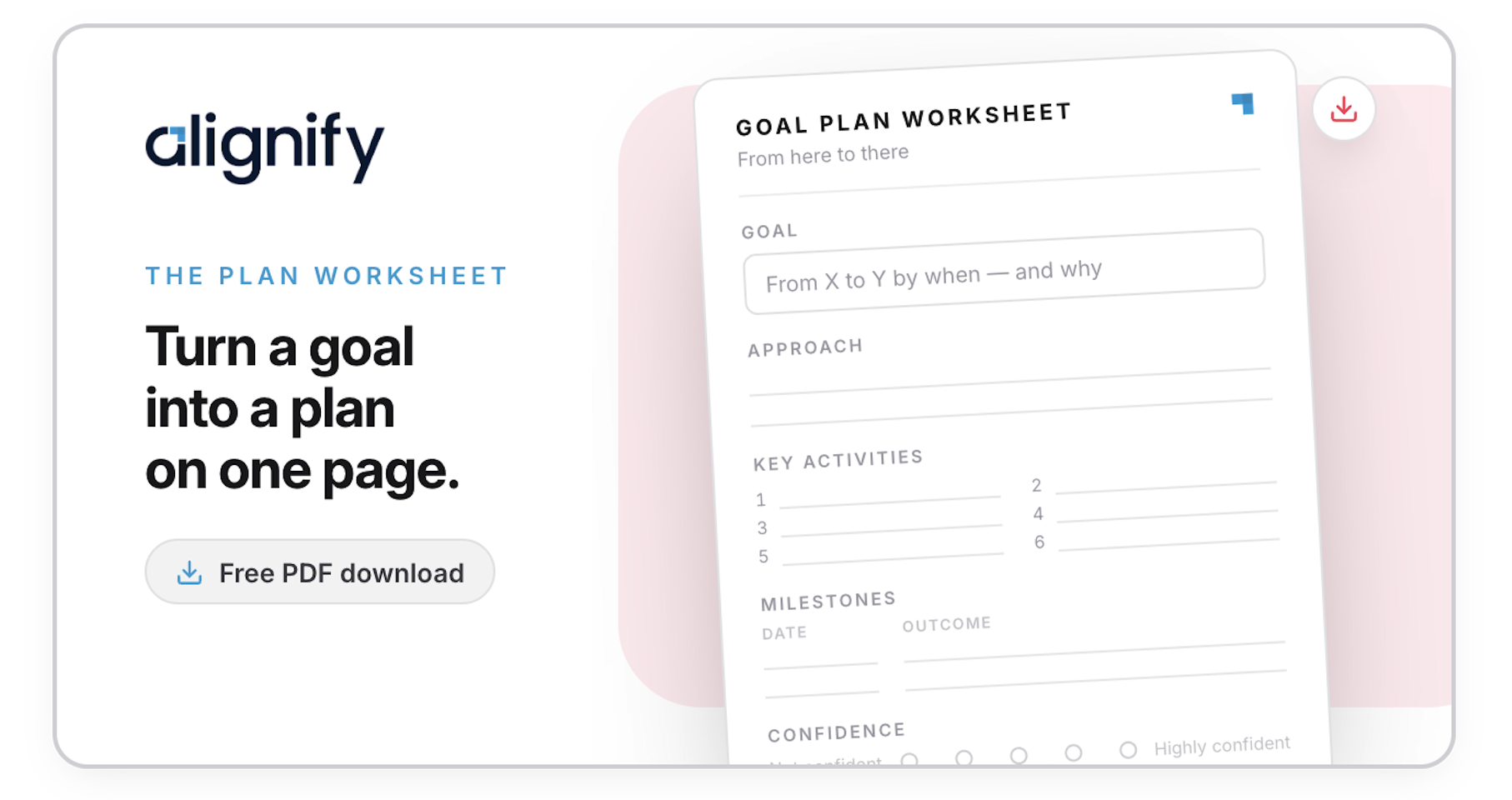
First, here's a template. We made a one-page Goal Plan Worksheet that will help you turn a goal into a plan. Print it, fill it out by hand at your next team meeting, and you'll leave with a real plan instead of a better-looking list of goals. Grab the free PDF download here.
Second, the software. Inside Alignify, the plan lives right alongside the goal — the same six parts from the worksheet above, just in a form your whole team can see and update together. You can draft it with AI, rate your confidence before you launch, and route it for approval or team review so the sign-off actually happens instead of living in someone's notebook. When the plan lives with the goal, your weekly check-in has something concrete to measure against. Watch how it works:
If you want the plan to live somewhere your whole team can see and update it, watch the Alignify demo or explore a sample account.
Third, the training replay. I taught this whole framework live in a free training called From Goals to Results. We build a plan together from a real goal, walk all six parts, and I show you the weekly rhythm that keeps it alive after the meeting ends. If your goals keep dying somewhere between January and June, the replay hour is for you.

Michael Lukaszewski
Michael is the founder of Alignify. He writes about goals, planning, and helping teams stay aligned on what matters most.